Blog
AI is Supercharging Autonomous Floor Cleaning Robots
Back to Blog(s)
November 18 2025
November 18 2025
How it Will Change Facilities Management
<Image Courtesy Pudu Robotics>
Autonomous floor cleaning robots are already transforming the way many facilities handle cleaning operations. They reduce labor demands, operate consistently, and help organizations maintain cleaner, safer environments with less effort. But until recently, most robotic floor cleaners followed a simple formula: map the space, follow preset routes, avoid obstacles, and repeat. Helpful? Undoubtedly! (And we should know, having deployed over 2,000 autonomous floor cleaning robots to customer sites across the country). But does the innovation stop there? Not even close.
Now, thanks to rapid advancements in artificial intelligence, floor cleaning robots are evolving beyond static maps and preset routes. They’re becoming smarter, more adaptive, and even more operationally valuable as the newest models and prototypes integrate AI capabilities with already-proven reliability and cleaning power.
Smarter Navigation: From Fixed Paths to Intelligent Movement
The early generations of floor cleaning robots were useful, but not truly autonomous in terms of navigating the environment. Their navigation systems relied on things like magnetic floor tape, wall markers, or rigid digital maps. If the environment changed (furniture moved, displays rearranged, work zones shifted) these robots didn’t adapt. They stopped, rerouted inefficiently, or required human intervention to reprogram their paths.
Modern floor cleaning robots overcame this smart navigation barrier to become truly autonomous by using a holistic synthesis of LiDAR, cameras, sonar and SLAM algorithms to self-navigate and avoid obstacles.
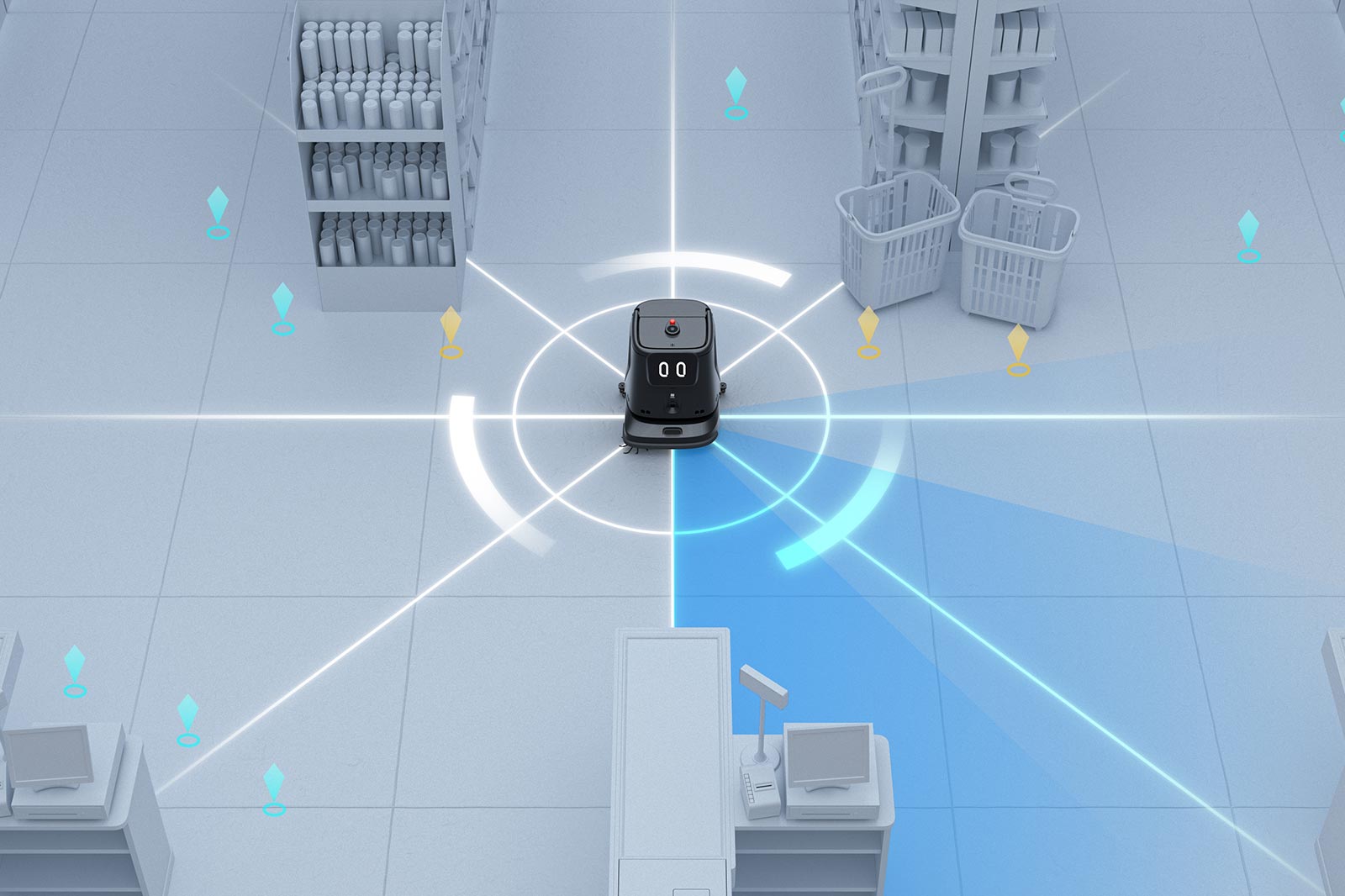
Now, new AI-enabled robots entering the market are fundamentally redefining what navigation can be. By incorporating AI vision and deep learning into the mix this next generation of robots can build and continuously update a virtual model of the facility. Moreover, beyond mapping lies interpretation—the capability to distinguish between permanent structures and temporary objects such as carts, chairs, and inventory. This means instead of merely avoiding obstacles, they understand their environment.
If a hallway is frequently blocked during shift changes, the robot learns and adjusts its cleaning schedule automatically. If event setups alter the layout overnight, the robot recognizes the change and adapts without requiring a technician to re-map routes (see one client’s story about how the Pudu MT1 did this on his tennis courts). Navigation becomes dynamic, aware, and optimized so that cleaning continues efficiently, no matter how busy or unpredictable the space becomes.
Proactive Detection: Seeing More, Responding Faster
Traditional cleaning robots approach cleaning as a coverage equation. Follow the plan, complete the assigned path, and avoid anything unexpected. While this type of predictable cleaning is still a huge boon to facilities management, real life can throw a wrench in the process in the form of unpredictable spills, debris, or other obstacles that might affect a robot’s cleaning run.
AI-powered robots flip that equation. Equipped with advanced vision models and machine learning systems trained to identify hazards, they can detect spills, debris, stains, or foreign objects in real time. More importantly, they make decisions based on what they see.
If a wet hazard appears in a high-traffic area, the robot can tailor both its cleaning path and approach to achieve the best results, whether that means slowing down, increasing scrubbing pressure, or returning multiple times until the floor is restored.
New AI-powered models like the Pudu CC1 Pro are also able to monitor and evaluate their own cleaning performance in real time, detecting leftover stains, triggering spot re-cleaning, and generating heatmaps after each task for clear insights into cleaning results. These units can also monitor floor cleanliness, adjusting the cleaning mode to conserve battery in clean areas and switching to deep cleaning mode in dirty areas.
Over time, these AI-enabled systems will learn to recognize where issues occur most frequently—thresholds, hallways, cafeterias—and proactively increase attention in those areas.
Adaptive Learning and Continuous Improvement
AI gives robots the ability to learn from every shift. They analyze historical cleaning data like performance trends, traffic density, and soiling patterns, and adjust to maintain consistent cleanliness with maximum efficiency. While all cleaning robots deliver a useful level of automation, the newest AI-enhanced systems deliver intelligent optimization.
For facilities managers, that will mean:
- Routes become more efficient over time
- Cleanliness remains consistent even as building usage changes
- Less time is spent correcting behavior or updating maps
- Operational performance improves without additional labor
What once required regular human adjustment will soon happen autonomously in the background. The longer the robot works inside a facility, the better the results become—a capability that simply didn’t exist in earlier automation models.
A Closed-Loop Cleaning Process
As cleaning robots evolve to elegantly incorporate AI perception and control systems, a fully automated, closed-loop cleaning process becomes not only possible, but the logical next step.
Becoming more than useful, automated cleaning equipment, cleaning robots will autonomously manage the entire cleaning cycle—from soiling/debris detection and adaptive cleaning adjustment to real time cleanliness assessment, along with an increasing degree of self “awareness” and internal components monitoring.
A Future of Fully Autonomous Facility Care
As AI pushes robotic cleaning beyond simple task automation toward true holistic facility intelligence, navigation, hazard detection, and adaptive cleaning strategies are only the beginning. As AI continues to evolve, robots will increasingly:
- Anticipate needs before they arise
- Coordinate with other service robots and building systems
- Automatically adjust routes based on occupancy and traffic
- Provide real-time confirmation of cleaning performance
- Eventually self-maintain to a large degree, reducing the need for frequent maintenance
At Pringle Robotics, we’re committed to staying on the leading edge of cleaning automation, but only insomuch as it is proven, vetted, and works for our customers in the real world. We’re watching the developments in AI-enabled cleaning robots closely, and will continue to add models to our lineup that offer the value and functionality our customers need. If you’re interested in learning more about the AI-powered robots in our current lineup, get in touch today to speak with one of our robotics experts.
Leave a comment below...